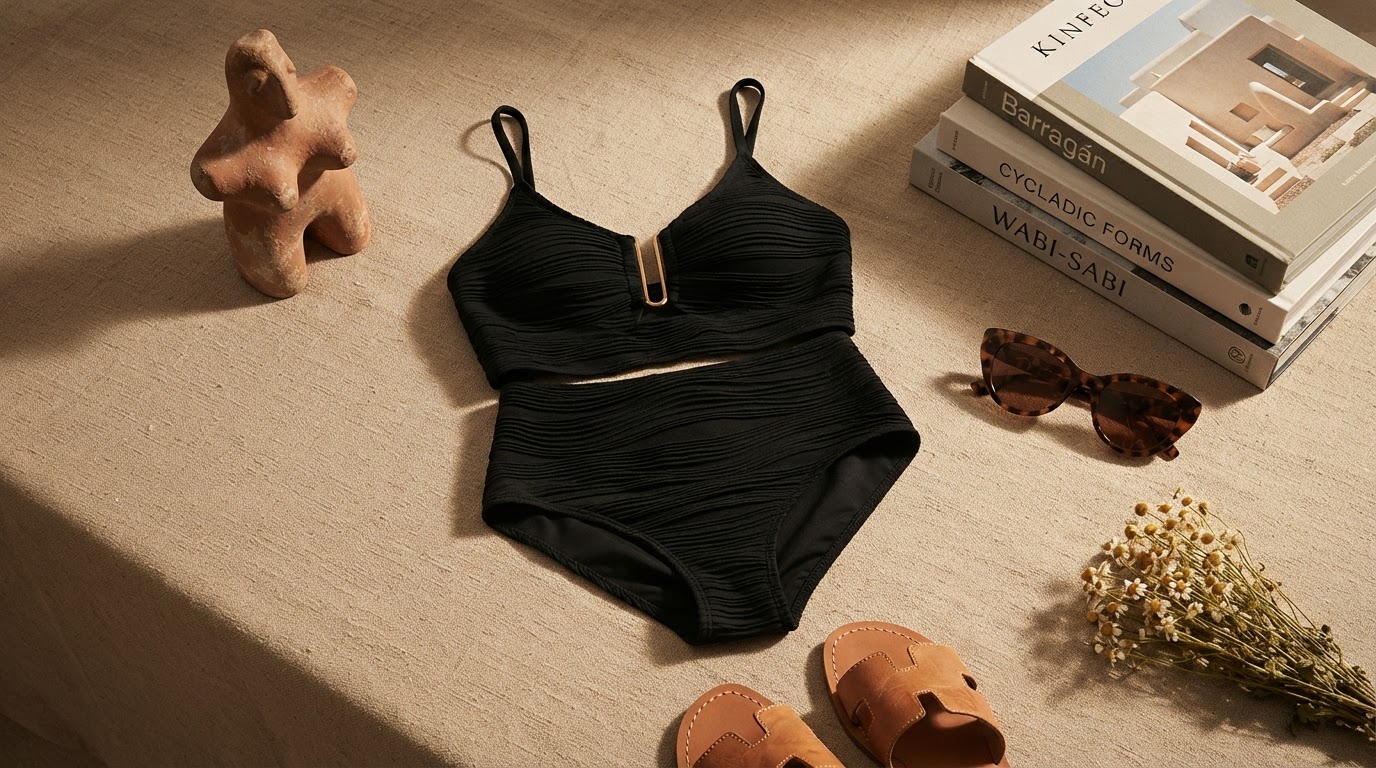
Architectural Integrity of the U-Wire Cutout High Waisted Swimsuit
 Maya ChenContributing Editor
November 2, 2026. This analysis examines the technical construction of the U-Wire Cutout High Waisted Textured Swimsuit and its role in the shift toward sculptural resort wear. It is written for consumers prioritizing structural longevity over disposable seasonal trends.
The Failure of Standard Cutout Construction
The conventional wisdom says that cutouts are merely aesthetic choices—negative space used to break up the monotony of a one-piece. However, this perspective ignores the structural reality of swimwear under tension. According to Simply Beach, a cut out swimsuit is traditionally a one-piece with sections of fabric removed to reveal skin, but the industry has long struggled with the 'sag' factor where the removal of fabric compromises the garment's ability to stay in place. When a designer removes a lateral section at the waist or ribs, the vertical tension of the suit is broken. In standard spandex blends, this leads to rolling edges and a loss of support that typically requires high-elastane counts just to maintain basic coverage. Architectural swimwear seeks to solve this by treating the garment as a piece of sculpture rather than a simple second skin. As noted in the Architectural Swimwear: Sculptural Cutout Design Guide, while standard cutouts are resort staples, the emerging sub-trend of sculptural design utilizes rigid elements to maintain the silhouette's geometry. The architectural neck swimsuit high waist trend demonstrates that without a central anchoring point, these designs usually fail during active use. The problem is not the absence of fabric; it is the absence of a frame.
Structural Solutions in the U-Wire Cutout High Waisted Textured Swimsuit
Here's the part nobody talks about: most cutout suits rely on the wearer's body to provide the tension that holds the suit's shape. The U-Wire Cutout High Waisted Textured Swimsuit rejects this reliance by integrating a rigid hardware element—the u wire cutout swimsuit frame—into the bodice. By using a u shaped wire bikini top foundation, the garment creates a fixed perimeter that does not collapse when the wearer moves. This is particularly critical when paired with textured fabrics like the ribbed high waist cutout swimsuit variations found in current market data. Texture adds weight and thickness; without the internal u bar cutout swimwear support, a heavy ribbed fabric would naturally pull downward, distorting the cutout. The high-waisted component of this specific suit serves as a secondary anchor, pulling the lower half of the garment upward to meet the wire frame. Run the math: a standard bikini top offers two points of tension (straps and back band), whereas the U-Wire system adds a third, inflexible axis. This allows for a deeper, more dramatic cutout without the risk of the fabric migrating. Unlike the flimsy alternatives often seen on Pinterest, which Doll House notes are the defining silhouette of 2026, the U-Wire version prioritizes mechanical stability. The textured fabric isn't just for visual depth; the increased surface area of the ribbing provides more friction against the skin, further stabilizing the high-waisted bottom against the architectural top.
A Framework for Evaluating Structural Swimwear
When transitioning from traditional silhouettes to architectural pieces, the evaluation process must shift from 'how it looks' to 'how it holds.' The U-Wire Cutout High Waisted Textured Swimsuit performs well because it treats the u wire cutout swimsuit as a load-bearing element rather than a decorative trim. I'll change my mind when a fabric-only cutout can maintain a 4-inch gap under water-weight without visible distortion, but until then, hardware is a necessity. Use the following checklist to determine if a structured suit meets architectural standards:
- Frame Rigidity: Ensure the U-wire or U-bar is coated to prevent oxidation and has enough gauge thickness to resist bending under bust weight.
- Fabric Weight: Textured or ribbed materials should have a minimum GSM (grams per square meter) high enough to prevent transparency when the architectural gaps stretch the surrounding fibers.
- Anchor Points: The high-waisted bottom must feature a reinforced waistband to act as a counter-tension to the upper U-wire.
- Seam Reinforcement: Look for double-stitched piping around the cutout edges to prevent the rolling that common spandex suits suffer from.
- Hardware Placement: The U-wire must be centered precisely to distribute tension evenly across the ribcage, preventing the lopsided fit common in asymmetrical cutouts.
Sources
- Why Wear Cutout Swimsuits in 2026: Style Guide - Doll House
- Architectural Swimwear: Sculptural Cutout Design Guide
- Cut Out Swimsuits